





Kintra Home DOMISANA
Kintra Home DOMISANA
Dries fast. Folds flat. Disappears when you're done.Diatomaceous stone absorbs completely and stays naturally antibacterial — the way your counter was always supposed to look.Machine washable. No mold. No scrubbing. No permanent rack taking up your space.
- Instant Absorption
- Anti-Mold & Antibacterial
- Diatomite Stone Material
Currently 32 items are in stock!
Couldn't load pickup availability
Description
Description
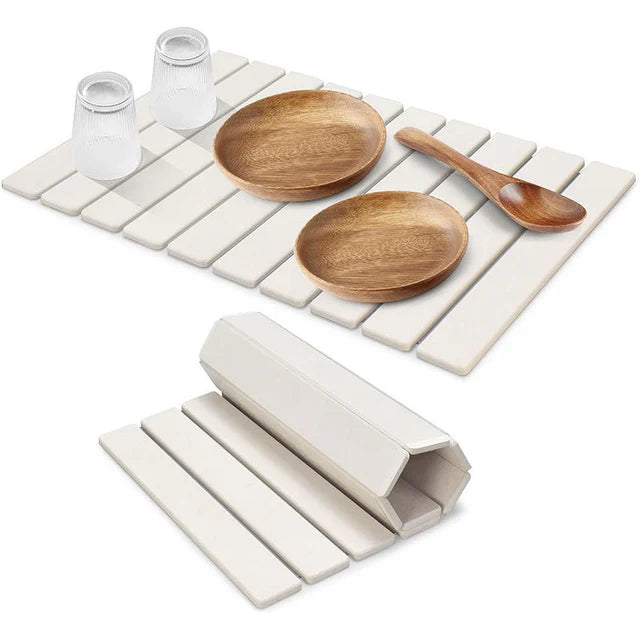
Instant-drying diatomite stone mat that absorbs water in seconds, keeps countertops spotless, and folds neatly for effortless kitchen organization.
- Instant water absorbing stone surface
- Anti-mold & antibacterial fast dry tech
- Heat-resistant, durable, long-lasting
- Space saving foldable design
- Multi-use: dishes, bathroom, pets, plants...
Material Diatomite (stone powder blend)
Care: Hand wash gently, allow to fully air-dry; avoid dark liquids to prevent staining.
Available Sizes:
- 40 × 30 cm (16 × 12 in)
- 60 × 40 cm (24 × 16 in)
Package Includes: 1 x Stone Mat
Shipping
Shipping
- Free Worldwide Shipping
- All orders are dispatched within 1 to 3 business days with tracking sent directly to your email.
Our 90-day Guarantee
Our 90-day Guarantee
Simple: try the Folding Stone Mat for a full 90 days. If your counter isn't cleaner, if mold and limescale come back, or if you find yourself missing your old dish rack — we'll refund every cent. No restocking fee. No return shipping to pay. No hoops to jump through.
Why 90 days? Because the real test isn't the first week. Anyone can feel good about a new kitchen purchase on day one. The real question is what happens at week three, week six, month three — when your old rack would have started rusting, building up crust, growing things in corners you can't reach. That's exactly what we're giving you time to see. Ninety days to prove that none of that happens.
We can offer this guarantee for one reason: over 93% of customers who try it never go back to a dish rack. The stone works. The product works. And if you're the rare exception, you're fully covered.
This offer is for limited time only! Buy before price increase.
View full details




They Tried It. Here's What Happened.

Diatomaceous earth is made up of millions of microscopic pores that pull water away from surfaces instantly — the same natural structure that prevents mold, bacteria, and odor from ever taking hold in the first place.
When a mat is built from that material, you're not just drying dishes faster. You're removing the one object that quietly bothered you every single time you walked into your kitchen.
That's the part most people don't expect.
Dr. Kasey Stopp
Food Scientists

Most drying solutions fail because they become permanent fixtures — you put them on the counter once and they never leave. The kitchen gets designed around them instead of the other way around.
The fold-flat design on this one changes that entirely. It's there when you need it, gone when you don't — which means your counter finally works the way a well-designed kitchen is supposed to work.
That's where the real difference in how your kitchen feels actually happens.
Emily Hodgson
Professional Kitchen Designers

Most cleaning products mask. Diatomaceous earth eliminates.
It absorbs moisture at the microscopic level — which is the only place mold, bacteria, and odor actually start. No moisture means no growth. Not slowed. Not treated. Structurally prevented.
That's real hygiene, not the appearance of it.
Dr. Lisa Chen
Microbiologists

I recommend diatomaceous stone for kitchen drying surfaces because no coating or antibacterial treatment can replicate what the material does structurally. Treatments wear off. The stone doesn't.
The reason I recommend this one specifically is the construction — compressed dense enough to absorb instantly without crumbling, with a fold mechanism that holds its integrity wash after wash, so even heavy daily use doesn't degrade it over time.
Dr. Daniel Mitchell
Materials Specialist
Why 50,319+ People Finally Got Their Counter Back

The Part Of Your Kitchen That Finally Works.
One fold and it's gone. Your counter stays clear without you having to think about it.
Science-Backed Material
Trusted by specialists. No rust. No mold. No scrubbing.
Stays In Place. Stands The Test.
Non-slip base grips the counter. Compressed stone construction. No sliding, no cracking, no wearing out.